
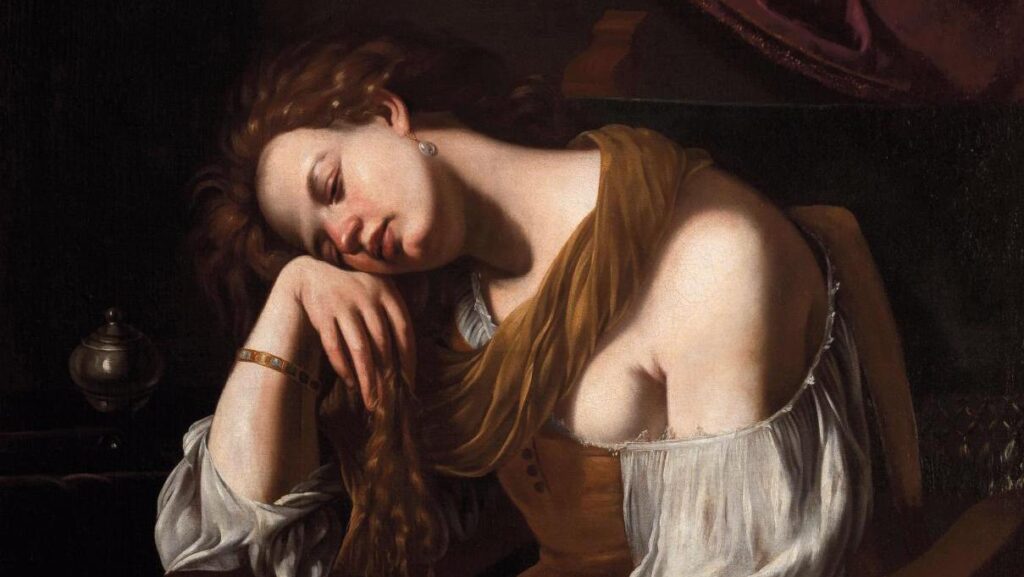


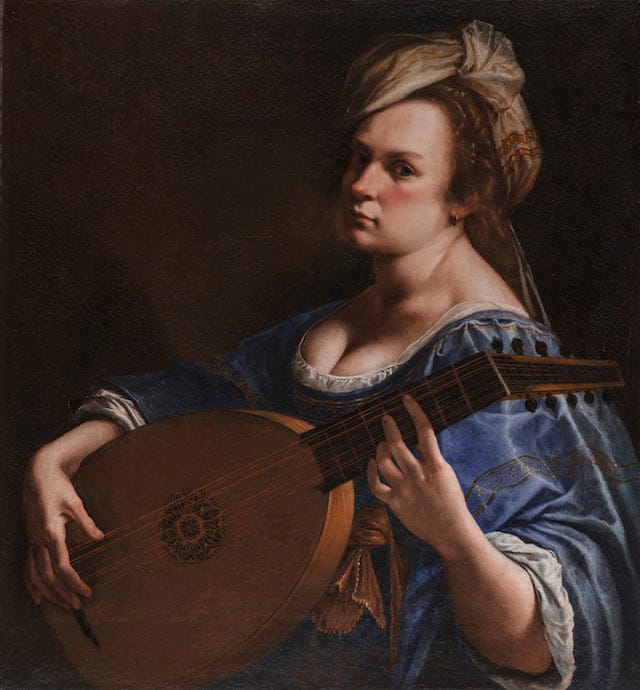
International Women’s Day serves as a powerful reminder for the art world to look again — and look more carefully — at the women who altered its course. Few figures demand that reconsideration more forcefully than Artemisia Gentileschi. A master of the Italian Baroque whose career spanned Rome, Florence, Venice, Naples, and London, Artemisia transformed personal adversity into paintings of extraordinary authority.
The recent acquisition of her work by the National Gallery of Art signals more than institutional validation. It reflects a broader recalibration within museums and collections worldwide: Artemisia is no longer framed as a compelling exception — she is recognized as a central protagonist in 17th-century European painting.
Formation in the Shadow and Light of Caravaggio
Born in Rome in 1593, Artemisia trained in the studio of her father, Orazio Gentileschi, whose refined naturalism absorbed the seismic impact of Caravaggio. Caravaggio’s dramatic chiaroscuro, radical realism, and psychological immediacy shaped the visual language of Rome at the turn of the century. Artemisia mastered that language with astonishing speed.
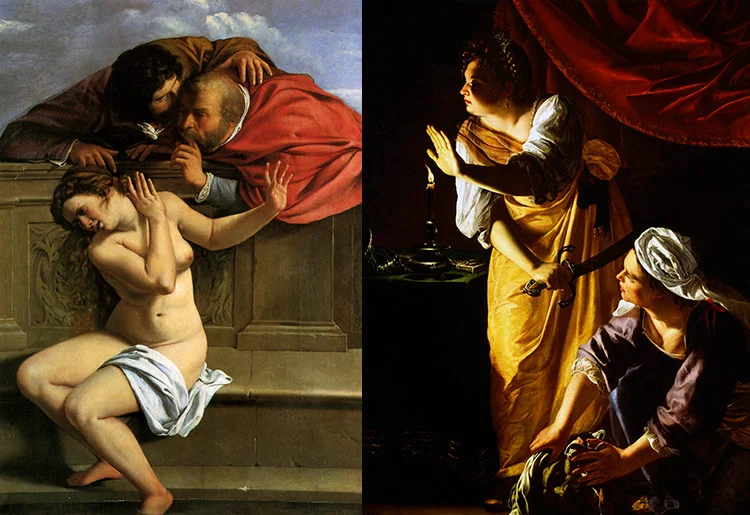
Her early masterpiece, Susanna and the Elders (1610), painted when she was just seventeen, already reveals a decisive departure from convention. Unlike many male interpretations of the subject — which often aestheticize Susanna’s vulnerability — Artemisia composes the scene from the woman’s perspective. Susanna twists away, her body tense, her face registering palpable distress. The elders loom intrusively, invading her physical and psychological space. The compression of the pictorial field intensifies the drama; the light isolates Susanna’s form while exposing the predatory gestures of the men.
Even at this early stage, Artemisia demonstrates a rare capacity to align formal decisions — composition, gesture, illumination — with emotional truth.
Trial and Transformation
The 1612 trial following her assault by Agostino Tassi remains one of the most documented episodes in early modern art history. Court transcripts reveal not only the brutality of the event but the systemic humiliation Artemisia endured, including torture intended to verify her testimony.
While scholars caution against reductively reading her paintings as autobiographical revenge narratives, it is undeniable that after the trial her depictions of biblical and mythological heroines acquire an intensified psychological charge.
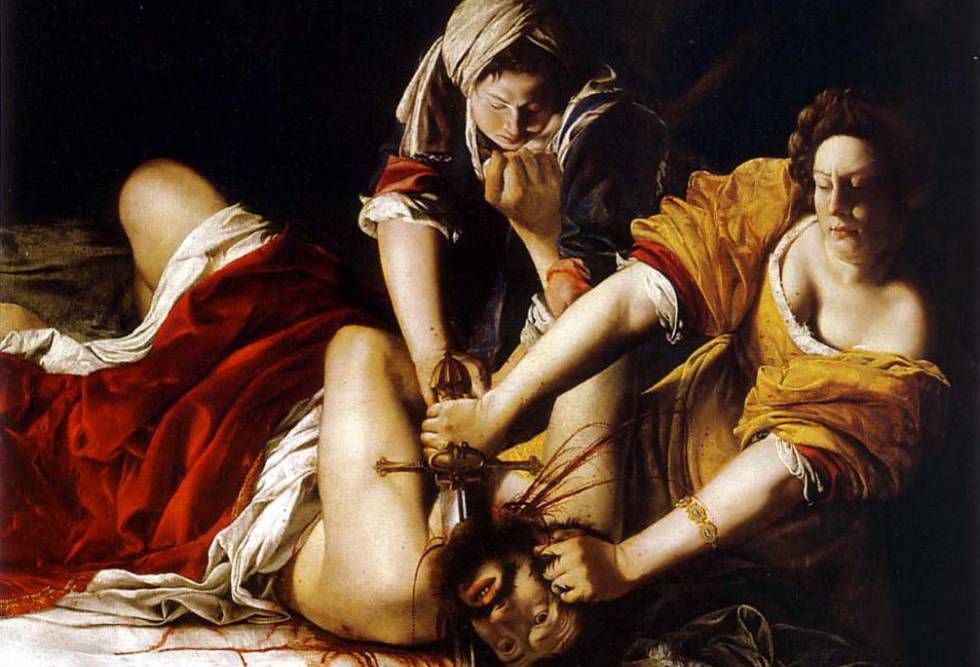
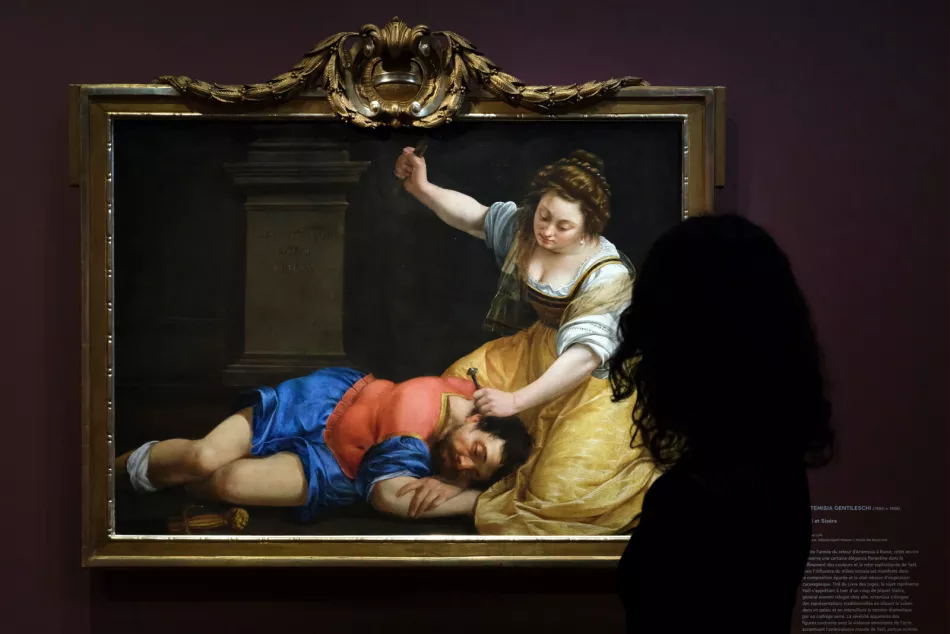
Her Judith Beheading Holofernes (c. 1620) stands as one of the most visceral images of the Baroque. Compared to Caravaggio’s earlier treatment of the subject, Artemisia’s composition is more compressed, more physical, more unflinching. Judith does not recoil. She leans into the act with determination; her maidservant is an active accomplice rather than a passive witness. The spurting blood arcs across the linen with startling realism. The scene is not theatrical spectacle — it is focused, muscular action.
Artemisia’s command of light heightens the psychological intensity. Illumination isolates the protagonists against a dark ground, creating a sculptural immediacy that pulls the viewer into the confined space of the tent. Flesh tones are rendered with weight and warmth; fabric folds are articulated with tactile precision. Violence here is not stylized — it is embodied.
Florence and Intellectual Ambition
After relocating to Florence, Artemisia achieved what no woman before her had, admission in 1616 to the Accademia delle Arti del Disegno. This was not symbolic membership; it granted professional legitimacy, access to patrons, and participation in intellectual circles that included Galileo Galilei.
In Florence, her palette brightened and her compositions grew more expansive. Works such as Judith and Her Maidservant (c. 1645-50) explore suspense rather than climax. Candlelight flickers across metallic surfaces; shadows swallow the surrounding darkness. Artemisia demonstrates sophisticated control over nocturnal effects, rivaling her male contemporaries in technical complexity.
Equally compelling is her series of self-fashioning portraits. In Self-Portrait as the Allegory of Painting (c. 1638–39), she accomplishes a conceptual coup: because the Renaissance scholar, Cesare Ripa’s emblem book, the “Iconologia” defined “Painting” as female, only a woman artist could convincingly embody the allegory. Artemisia presents herself mid-action, sleeves rolled, brush in hand, turning away from the viewer as she works. The image collapses the distance between creator and concept. She is both painter and Painting, both subject and author.
For artists today, this work resonates as an early assertion of creative agency. For art historians, it marks a sophisticated engagement with iconography and self-representation.
Naples, London, and International Reach
Artemisia’s later career in Naples solidified her reputation as a painter of large-scale altarpieces and complex multi-figure compositions. In works such as The Birth of Saint John the Baptist, she orchestrates spatial depth with architectural framing and dynamic figural groupings. Her handling of color becomes increasingly luminous; blues and reds vibrate against earthen tones, revealing a dialogue with Venetian painting.
Her time in London, working alongside Orazio at the court of Charles I, positioned her within an international network of collectors attuned to continental innovation. That a woman artist could sustain such a transnational career in the 17th century remains extraordinary.
Market, Museums, and Canon Revision
The renewed institutional commitment to Artemisia’s oeuvre reflects decades of scholarship that have dismantled outdated narratives minimizing her contribution. Major retrospectives across Europe and the United States have repositioned her not as a curiosity, but as a foundational Baroque master.
The National Gallery of Art’s acquisition reinforces this shift. For collectors, Artemisia represents both art historical gravitas and market strength; her works have achieved record prices at auction in recent years, underscoring sustained demand. For museums, acquiring her paintings is not merely corrective — it is essential to presenting a truthful account of 17th-century artistic production.
Relevance on International Women’s Day
International Women’s Day offers an opportunity to consider Artemisia beyond biography. Her significance lies not solely in overcoming adversity, but in the quality and ambition of her art. She claimed space within the most prestigious genre of her time — history painting — and executed it with authority equal to any of her contemporaries.
Her women are thinkers, strategists, saints, musicians, rulers. They inhabit their narratives with conviction. Artemisia’s brush does not sentimentalize; it dignifies.
For artists, her legacy affirms that authorship can be reclaimed through mastery. For collectors, her work embodies both aesthetic power and cultural resonance. For institutions, her presence demands a broader, more inclusive canon.
Artemisia Gentileschi did not simply paint powerful women. She painted power itself — and in doing so, secured her place among the great masters of the Baroque.



#/media/File:Nacimiento_de_San_Juan_Bautista_(Artemisia_Gentileschi).jpg)
